High leverage forex brokers were a major draw for traders with small accounts in 2027, and this guide compares seven of the names that stood out that year. We look at leverage ratios, margin requirements, regulation, minimum deposits and bonus offers, so you can see the tradeoffs behind each broker’s pitch.
📑 Table of Contents
The biggest question is simple: which brokers delivered high leverage without cutting corners on fund safety? The answer depends on where the account was regulated, not just on the number advertised. The figures below reflect the terms described for 2027, and broker conditions change, so always check current terms directly with the broker. For a wider list, see our 9 Best High Leverage Forex Brokers in 2027.
Seven High Leverage Brokers Compared
Each profile covers the same points: maximum leverage, regulation, minimum deposit, bonuses and who the broker suits. The same broker can run several entities, and each entity may offer different leverage and protection, so check the entity you would actually open.
1. FBS
FBS built its reputation in 2027 as the go-to name for traders who wanted very high leverage without a large starting balance. Its leverage settings backed up its accessibility-focused marketing more strongly than most competitors.

Leverage, regulation and deposits
FBS offered leverage up to 1:3000 on its Cent accounts in 2027, while Standard and Zero Spread accounts topped out around 1:1000. A trader with $10 could control positions worth $30,000 on a Cent account, but margin calls arrived fast if a trade moved against them.
The high-leverage accounts sat under an IFSC Belize license. Belize is an offshore regulator with limited enforcement power compared with tier-1 authorities, so fund protection and dispute resolution depended heavily on FBS’s own policies. Minimum deposits started around $1 on some account types, with funding possible by card, e-wallet and regional payment methods.
Accounts were split by trading style and leverage cap:
| Account Type | Min. Deposit | Max Leverage | Spread From |
|---|---|---|---|
| Cent | $1 | 1:3000 | 1 pip |
| Micro | $5 | 1:3000 | 1 pip |
| Standard | $100 | 1:1000 | 0.5 pip |
| Zero Spread | $500 | 1:1000 | 0 pip + commission |
Bonuses and who it suits
FBS ran a $140 no-deposit bonus for new sign-ups in several regions, alongside a 100% deposit bonus matching funded accounts up to a set cap. Affiliate cashback added value for active traders. Small-account traders and scalpers found the most value here, thanks to tight entries on Zero Spread accounts and extreme leverage on Cent accounts. Traders who prioritized tier-1 regulation generally looked elsewhere.
2. Exness
Exness carved out a different niche in 2027, pairing high leverage with a reputation for transparency that few offshore brokers matched. It appealed to traders who wanted large position sizing without feeling they had signed up with a fly-by-night operation.
Leverage and regulation
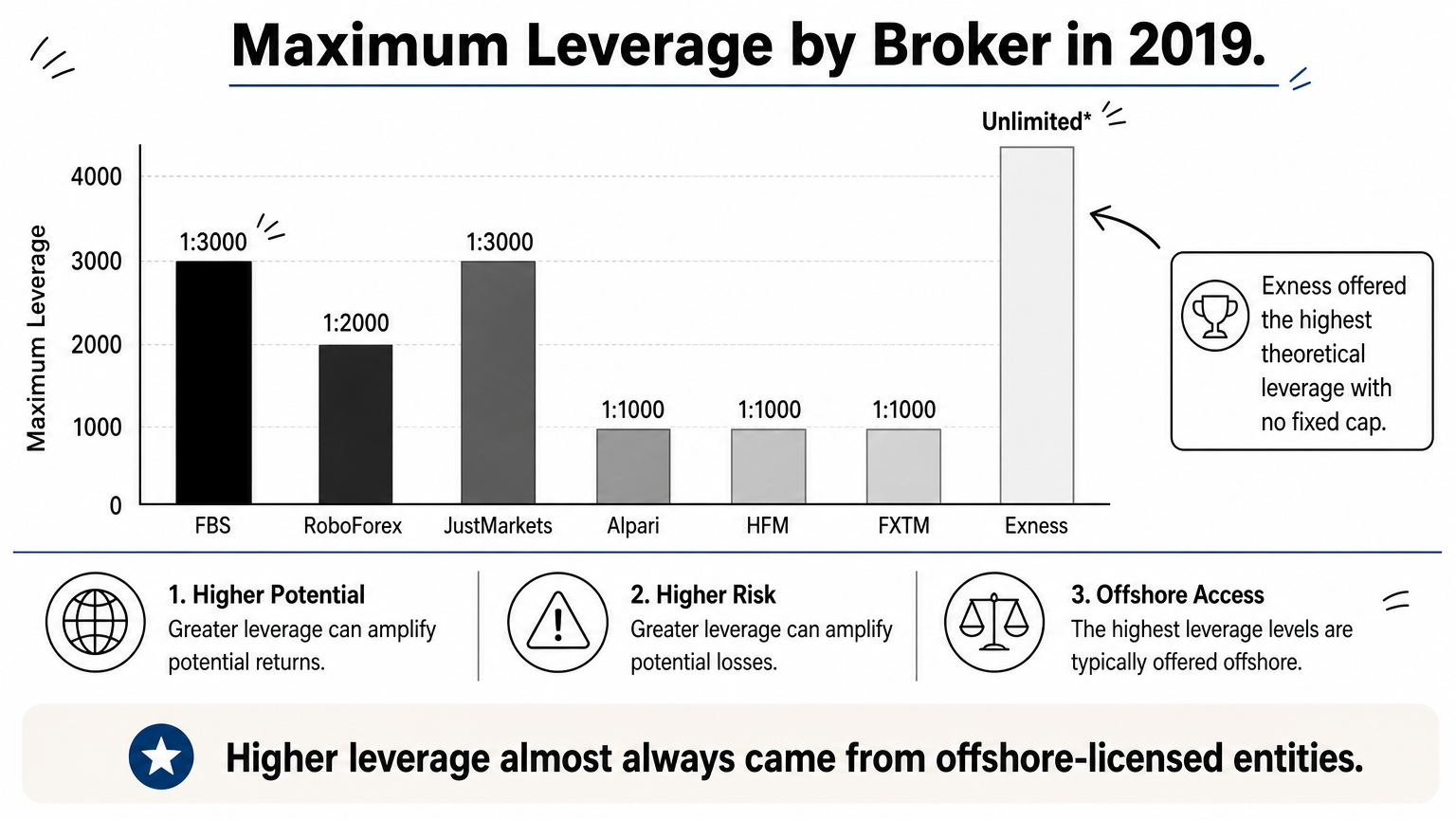
Exness offered leverage of up to 1:unlimited on select accounts in 2027, a figure that drew attention on trading forums. In practice, this applied under specific volume and balance conditions, and dynamic margin requirements tightened as position sizes grew. Standard accounts typically offered leverage up to 1:2000.
Unlimited leverage sounds like freedom until margin math reminds you it’s still a loan, not a gift.
Jurisdiction matters here. Exness held FCA licenses in the UK and CySEC licenses in Cyprus for its regulated entities, while the ultra-high leverage accounts operated under offshore licenses from Seychelles and the British Virgin Islands. Traders chasing maximum leverage therefore sat outside the reach of stricter European oversight.
Deposits, bonuses and who it suits
Standard accounts opened from as little as $1, and Standard Cent accounts let traders practise with real money at very low risk. Pro and Raw Spread accounts required larger deposits but offered tighter pricing. Bonus activity was lighter than at FBS, focused on cashback and rebates through affiliate partnerships. Exness suits growth-focused traders who value a credible regulatory footprint alongside aggressive leverage, especially those planning to increase account size over time.
3. RoboForex
RoboForex earned a loyal following in 2027 among traders who wanted flexibility without giving up serious leverage. Its multiple account types and reputation for fast execution made it a common comparison point against FBS and Exness.
Leverage and scaling
RoboForex capped leverage at 1:2000 across most retail account types, applied automatically while a trader’s balance stayed under a set threshold. Larger balances triggered tiered reductions, which guarded against the account blowouts that hit brokers offering flat high leverage regardless of deposit size.
Regulation, deposits and bonuses
The 1:2000 entity operated under an IFSC Belize license, while a separate CySEC-regulated arm served clients who needed EU-compliant terms with much lower leverage caps. RoboForex offered one of the lowest entry points in the industry, with accounts opened from as little as $10.
| Account Type | Min. Deposit | Max Leverage |
|---|---|---|
| Pro-Cent | $10 | 1:2000 |
| ProStandard | $10 | 1:2000 |
| Prime | $500 | 1:1000 |
| ECN | $500 | 1:300 |
Several promotions ran in 2027, including a welcome bonus and cashback offer matching new funding up to a fixed percentage, plus periodic trading contests with cash prizes for demo and live accounts. RoboForex suits budget traders who want flexible account structures and plan to test several strategies across Cent and Standard accounts before committing more capital.
4. Alpari
Alpari brought decades of brand recognition into 2027. Traders who wanted an established name behind their leverage, rather than an unfamiliar startup, often chose it. The broker split its offering across several corporate entities, each aimed at a different regulatory comfort level.
Leverage and margin
Alpari International offered leverage up to 1:1000 on Standard and ECN accounts in 2027. That satisfied most retail traders without pushing into the 1:2000 or 1:3000 range. Margin calls were flagged earlier than at some offshore peers, giving traders more time before automatic close-out. A slightly lower cap paired with earlier warnings can save an account that pure high-leverage brokers would have liquidated.
Regulation, deposits and bonuses
Alpari’s FSC Mauritius and IFSC Belize arms offered the full 1:1000 leverage, while its FCA-regulated UK entity capped leverage far lower. Your protection depended on which entity you signed up with, not just the Alpari brand. Standard accounts opened from $100, a Micro account lowered that to $5, and ECN accounts required $500 on raw spreads plus commission.
Alpari ran a 30% deposit bonus through much of 2027, applied to new funding up to a capped amount, along with periodic trading contests. It suits traders who want brand history and moderate high leverage, a middle ground between aggressive offshore offers and tier-1 conservatism.
5. JustMarkets
JustMarkets traded as JustForex in 2027, before its later rebrand. It drew traders comparing high-leverage offshore brokers alongside FBS and RoboForex. The pitch centred on flexible leverage and a straightforward account lineup.
Leverage and regulation
Leverage reached up to 1:3000 on select account types in 2027, matching FBS at the top of the market. Margin requirements followed a tiered structure tied to balance, so effective leverage shrank automatically as accounts grew.
The highest leverage numbers rarely stay available once your account balance actually grows, and that’s by design.
JustForex operated under an IFSC Belize license in 2027. No tier-1 regulator oversaw the entity offering 1:3000 leverage, so traders accepted weaker regulatory recourse in a dispute.
Deposits, bonuses and who it suits
Accounts opened from $1 on Micro and Cent variants, while Standard accounts required a higher deposit and traded on tighter spreads, offering a clear upgrade path. A welcome deposit bonus matched new funding up to a set percentage, and periodic cashback rewarded active volume through partner programs. JustForex suits traders wanting FBS-level leverage with a different pricing model, particularly if they were already comfortable with offshore-regulated entities.
6. HFM
HFM operated as HotForex in 2027. It had built a solid reputation among traders who wanted high leverage without the feel of a newer offshore startup. Its multi-regulated structure made it a frequent pick for traders who wanted some oversight alongside leverage.

Leverage and stop-out
HotForex offered leverage up to 1:1000 on its international entity in 2027. That was lower than the 1:3000 ceilings at FBS or JustForex, but still aggressive compared with anything available under EU rules. Stop-out levels applied earlier than at some offshore peers, limiting how far an account could fall before automatic liquidation.
Regulation, deposits and bonuses
HotForex held licenses from the FCA for its UK arm, CySEC for its EU entity and FSCA in South Africa, alongside its FSC Mauritius license backing the 1:1000 accounts. The highest-leverage accounts still sat under the lighter-touch Mauritius framework. Accounts opened from $5 on the Micro tier, with Premium and Zero Spread accounts requiring $100 and $200.
HotForex ran a 100% deposit bonus through much of 2027, plus loyalty cashback tied to trading volume. A HotForex welcome bonus for new and existing clients continues that tradition today, so check its current terms before claiming. HFM suits traders who want multi-jurisdictional regulation with solid leverage rather than the absolute highest ratio.
7. FXTM
FXTM rounded out the 2027 leverage conversation with a focus on execution speed and a wider regulatory footprint than most offshore-heavy names here. Traders comparing it with HotForex and Alpari often found the three offered a similar blend of aggressive leverage and multi-jurisdictional licensing.
Leverage, regulation and deposits
FXTM capped leverage at 1:1000 for its international accounts in 2027, the same ceiling as HotForex rather than the 1:3000 extremes. Margin requirements tightened automatically as positions grew. Its FSC Mauritius license backed the high-leverage international accounts, while its FCA and CySEC arms served traders who wanted stricter UK or EU protection at reduced leverage.
A 1:1000 ceiling still lets a small account punch well above its weight, just without the recklessness of a 1:3000 setup.
Cent accounts opened from $10, Standard accounts required $100, and ECN accounts started near $200 for traders who wanted raw spreads plus commission.
Bonuses and who it suits
Deposit bonuses ran periodically through 2027, matching new funding up to a set percentage, and trading contests rewarded consistent demo and live performance with cash prizes. FXTM suits traders who want regulatory flexibility alongside solid, if not extreme, leverage, especially those planning to move toward a more regulated entity as their account grew.
Summary Table of the Seven Brokers
| Broker | Top leverage (2027) | Main regulation described | Lowest deposit described |
|---|---|---|---|
| FBS | 1:3000 (Cent accounts) | IFSC Belize for high-leverage accounts | About $1 |
| Exness | 1:unlimited (select accounts) | FCA and CySEC; offshore for high leverage | $1 (Standard) |
| RoboForex | 1:2000 | IFSC Belize; separate CySEC arm | $10 |
| Alpari | 1:1000 | FSC Mauritius, IFSC Belize, FCA arm | $5 (Micro) |
| JustMarkets (JustForex) | 1:3000 (select accounts) | IFSC Belize | $1 (Micro and Cent) |
| HFM (HotForex) | 1:1000 | FCA, CySEC, FSCA, FSC Mauritius | $5 (Micro) |
| FXTM | 1:1000 | FSC Mauritius, FCA, CySEC | $10 (Cent) |
Finding the Right High Leverage Fit for You
Looking back at the 2027 leverage race, one pattern stands out. The brokers offering 1:2000 or 1:3000 ratios usually did so through offshore entities, while those capping at 1:1000 tended to carry stronger regulatory credentials. Neither approach is automatically wrong, but you need to know which tradeoff you are making before funding an account.
FBS and JustForex chased the highest numbers. HotForex, FXTM and Alpari balanced leverage against oversight. Exness and RoboForex sat in between, depending on which entity you signed up with.
Match any ratio against your actual account size and risk tolerance, not just the biggest number on a landing page. Position sizing and stop placement matter more than the leverage setting itself, so our guide to 7 Forex Risk Management Strategies Beginners Should Use is a useful next read. For regulatory background on leverage limits in Europe, the European Securities and Markets Authority website is a good starting point.
Conclusion
High leverage can make a small account useful, but it also magnifies losses. The seven brokers above show that the highest ratios usually came with the lightest oversight. Compare leverage, regulation, deposit size and bonus terms together, and verify current conditions before you trade.
FAQ
What is high leverage in forex trading?
High leverage lets you control a large position with a relatively small deposit, such as 1:500 or 1:1000. It increases potential gains but also increases potential losses, and margin calls can come quickly.
Which high leverage forex brokers offered the highest leverage in 2027?
FBS on Cent accounts and JustMarkets (then JustForex) on select accounts offered up to 1:3000, and Exness listed unlimited leverage on select accounts. Those ratios came with offshore regulation, so check the entity you would actually open.
Is high leverage safer with a regulated broker?
Usually, yes. Brokers with tier-1 licenses such as the FCA or CySEC generally offer stronger protection and lower leverage caps. Offshore licenses often allow higher leverage but provide weaker recourse.
How much money do I need to start with a high leverage broker?
Several brokers in this list accepted deposits of $1 to $10 on entry-level accounts. Low minimums do not reduce risk, so start small and size positions carefully.
Do bonuses make high leverage brokers a better choice?
Not on their own. Bonuses often come with withdrawal conditions and trading requirements. Read the terms before claiming any offer and compare them against regulation and execution quality.