Risk management is the single most important skill for a beginner forex trader, and most account losses come from risking too much per trade rather than picking bad entries. In forex, risk management means deciding before you enter how much you can lose and what you will do if the trade goes wrong. This guide covers seven strategies you can apply right away.
📑 Table of Contents
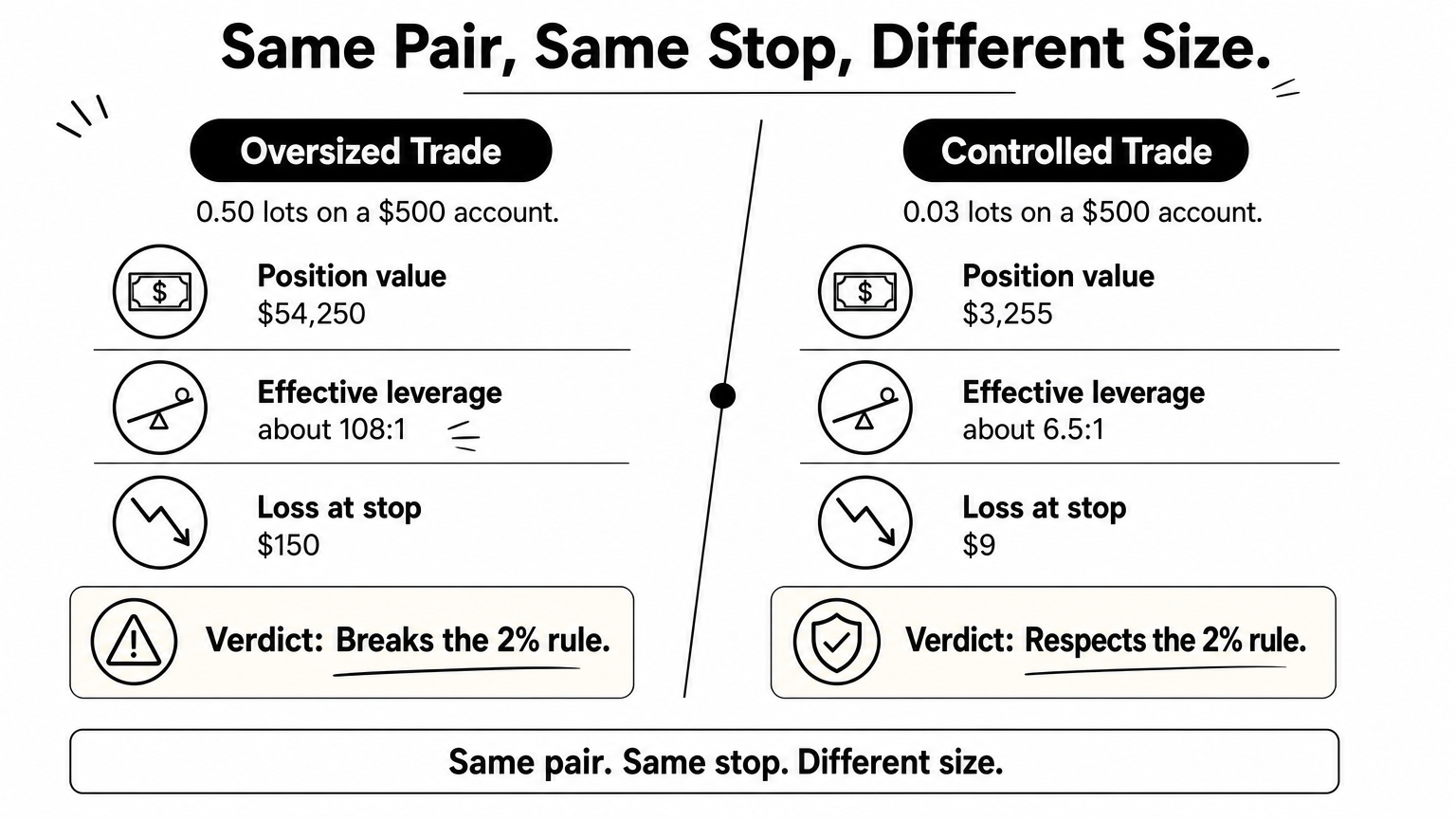
| Lot size | Position value | Effective leverage | Loss at stop | % of account |
|---|---|---|---|---|
| 0.50 | $54,250 | about 108:1 | $150 | 30% |
| 0.03 | $3,255 | about 6.5:1 | $9 | 1.8% |
Here is the short version. Risk only 1% to 2% of your balance per trade, set a stop-loss every time, and keep leverage under control. On a $100 account, that means risking $1 to $2 per trade, not $20.
Each strategy below includes a simple calculation, a worked example and the mistakes beginners make most often. Read them as a set, because they work together.
Seven Risk Management Strategies Every Beginner Needs
1. Risk only 1% to 2% of your account per trade
This is the foundation of sound risk management. You choose a fixed percentage of your balance, usually 1% to 2%, and that is the most you can lose if the trade hits its stop-loss. Because the percentage applies to your current balance, the dollar amount shrinks after losses and grows after wins.
The math shows why this works. At 2% risk, ten losses in a row leave you with about 82% of your account. At 20% risk, ten losses in a row wipe out roughly 89% of it. Every strategy has losing streaks, and a small fixed risk keeps them survivable.
How to calculate it: account balance x risk percentage = maximum dollar risk. With a $500 account and a 2% limit, you can lose $10 on a trade, and not a cent more. On a $50 bonus balance, 2% is $1 per trade, which keeps you trading small while you learn.
| Account balance | 1% risk | 2% risk |
|---|---|---|
| 0 | ||
| 0 | ||
| ,000 | ||
| ,000 | 0 |
Common mistakes to avoid
- Raising risk to win it back. Doubling your size after a loss is how one bad day becomes a blown account.
- Calculating on the wrong number. Use your real balance, not leverage-boosted buying power.
- Stacking 2% risks. Five open trades at 2% each put 10% of your account at risk at the same time.
- Treating 2% as a target. It is a ceiling. On shaky setups, risk 0.5% or skip the trade.
2. Use a stop-loss on every trade
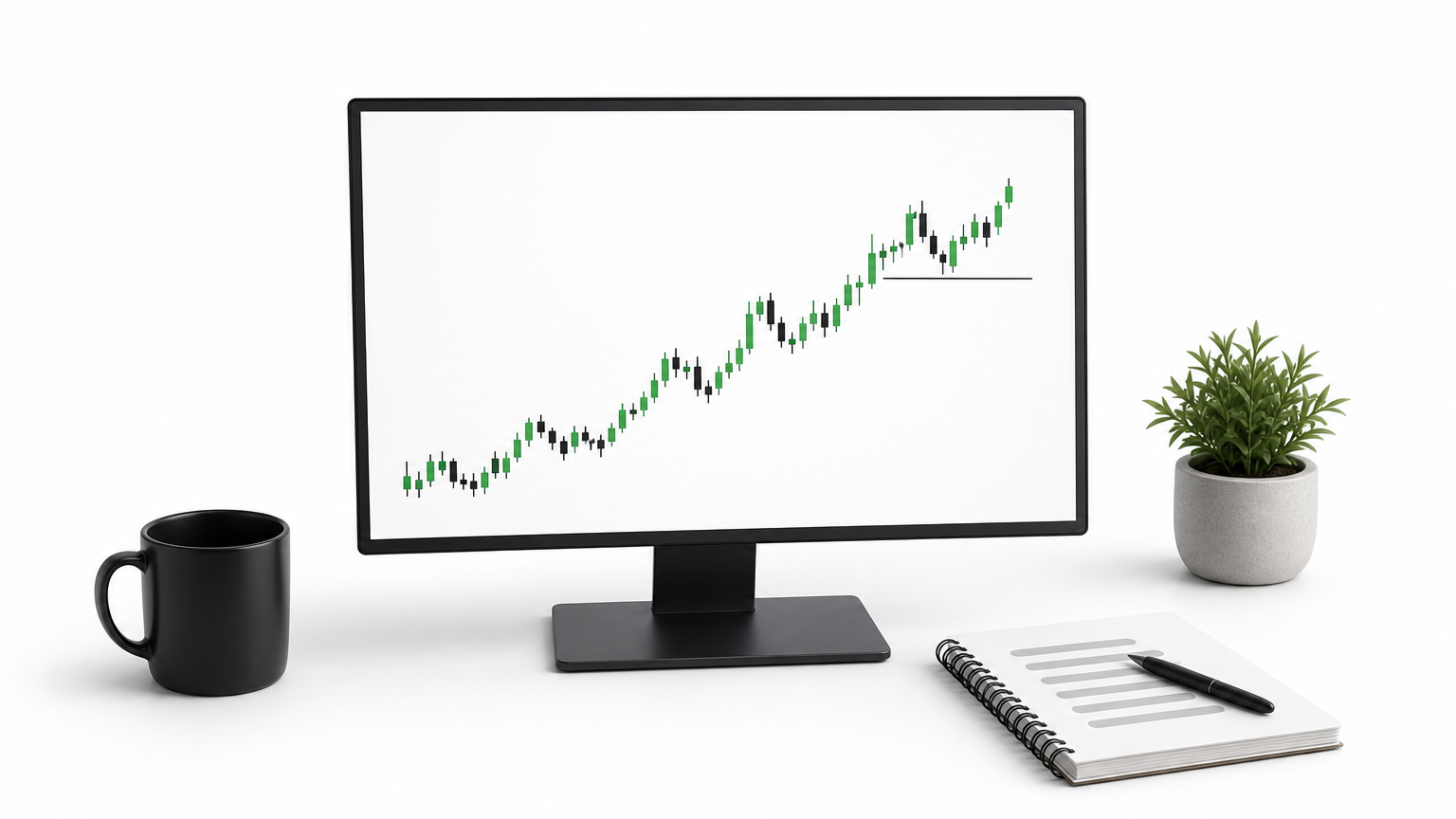
A stop-loss is an order that closes your trade automatically at a price you set in advance. It turns your 1% to 2% limit into a real price on the chart. Place it where your trade idea is proven wrong, such as just beyond a recent swing low or high, rather than at a random pip count.
Set the stop the moment you open the trade in MT4 or MT5. In fast markets, a stop can fill worse than your price, which is called slippage, so treat it as a strong safeguard rather than a perfect guarantee.
Example: You buy EUR/USD at 1.0850 with a stop at 1.0820 on a $500 account with a 2% limit. The stop distance is 30 pips. Maximum risk is $10, so the allowed value per pip is $10 / 30, or about $0.33. That works out to roughly 0.03 lots, risking about $9.
Common mistakes to avoid
- Moving the stop further away. Widening it because “it will turn around” turns a planned 2% loss into an unplanned 10% one.
- Placing it too tight. A 5-pip stop on a volatile pair gets hit by normal noise. Give the trade room and reduce the lot size instead.
- Using a mental stop. If the order is not in the platform, you will hesitate when it matters most.
3. Size every position before you enter
Position sizing connects your risk limit to the actual trade. The 1% to 2% rule gives you a dollar amount, and your stop-loss gives you a distance in pips. Lot size is the only variable left, so calculate it before you click buy or sell.
A 10-pip stop and a 50-pip stop need different sizes. Good risk management keeps the dollar risk constant while the lot size changes with the stop. A position size calculator can do this math quickly, but learn the formula so you can verify any number a tool gives you. For background on core trading terms, Investopedia offers beginner-friendly explanations.
Formula: lots = dollar risk / (stop in pips x pip value per lot). On EUR/USD, a standard lot is worth about $10 per pip, a mini lot about $1, and a micro lot about $0.10. On a $1,000 account with 1% risk and a 25-pip stop, dollar risk is $10, and the lot size is $10 / $250, or 0.04 lots.
Common mistakes to avoid
- Guessing the lot size. Picking 0.10 lots because it feels right ignores your stop distance completely.
- Rounding up. If the formula says 0.04 and your broker only allows 0.05, take 0.04 or skip the trade.
- Using the wrong pip value. Pairs like USD/JPY and metals like Gold have different contract specifications, so check them in MT4 or MT5.
- Sizing after entry. Adjusting the lot size once you are in the trade means you are already trading on emotion.
4. Set a minimum risk-reward ratio
The risk-reward ratio compares what you could lose with what you aim to gain. Set a minimum before you trade, such as 1:2, and skip any setup that falls short. This single rule turns a loose approach into a repeatable plan.
Win rate and ratio work as a pair. At 1:2, you only need to win one trade in three to break even. Even a 40% win rate leaves you ahead.
Example: You buy GBP/USD at 1.2700 with a stop at 1.2670 (30 pips) and a target at 1.2760 (60 pips). The ratio is 1:2. If you risk $10, a winning trade pays about $20.
| Win rate | Wins | Losses | Net result |
|---|---|---|---|
| 30% | + | – | – |
| 40% | + | – | + |
| 50% | +0 | – | + |
Common mistakes to avoid
- Inventing a target to reach 1:2. Place targets at real levels such as prior highs or support. If the nearest level only gives 1:1, skip the trade.
- Ignoring the spread. On a tight target, the spread takes a real share of your reward.
- Closing winners early. Taking 10 pips on a 40-pip target quietly pushes your effective ratio below 1:1.
- Chasing huge ratios. A 1:6 target that rarely gets hit loses to a 1:2 target that often does.
5. Keep leverage under control
Leverage lets you control a large position with a small amount of margin. At 1:500, $100 of margin controls $50,000. The catch is that leverage magnifies losses as much as gains. ValeTax offers up to 1:2000, but a high maximum does not mean you should use it. If you are comparing brokers on leverage, see our guide to 7 High Leverage Forex Brokers Worth Considering in 2027.
What matters is effective leverage: total position value divided by account balance. Treat the broker’s maximum as a ceiling, not a target. A sensible beginner limit is 10:1 or lower.
Example: On a $500 account, one standard EUR/USD lot with a 30-pip stop risks $300, which is 60% of the account. A 0.03-lot position on the same stop risks about $9, close to the 2% limit. Position size, not the broker’s leverage limit, sets your real risk.
Common mistakes to avoid
- Opening the largest lot your margin allows. Available margin shows what is possible, not what is safe.
- Ignoring margin level. A few open trades can shrink free margin fast, and a stop-out closes positions at the worst moment.
- Raising leverage to fix a small account. More leverage on $50 only makes a wipeout faster.
- Holding large positions through news. Spreads widen and prices can gap, so a stop may fill well past your level.
6. Avoid stacking correlated pairs
Correlated pairs tend to move together, so opening several of them is effectively one larger trade. EUR/USD and GBP/USD often rise and fall in step because both trade against the dollar. A single dollar move can hit every position at once, and your 2% rule quietly becomes 4% or 6%.
Example: On a $1,000 account with a 2% limit, you buy EUR/USD and GBP/USD, risking $20 on each. If the dollar rallies, both stops hit and you lose $40, which is 4% of your account. Correlations shift over time, so check a correlation matrix before you rely on one.
| Setup | Risk per trade | Total if both stop out |
|---|---|---|
| Both at 2% | + | (4%) |
| Both at 1% | + | (2%) |
Common mistakes to avoid
- Treating different pairs as different bets. Long EUR/USD, long GBP/USD and long AUD/USD are all bets against the dollar.
- Ignoring the shared currency. Before you click, check whether the same currency sits on the same side of another open trade.
- Trusting old correlation data. Relationships change with interest rates and news, so recheck them regularly.
- Forgetting Gold. Gold is priced in dollars and often moves against the dollar, so it can stack with your USD trades.
7. Write a trading plan and keep a journal
A written plan turns the strategies above into rules you follow without debating them mid-trade. A solid risk management plan fits on one page and answers these questions:
- Risk per trade: 1%, never above 2%
- Daily loss limit: for example 3%, after which you stop for the day
- Maximum open trades: for example 3
- Pairs you trade: liquid ones such as EUR/USD, GBP/USD and USD/JPY
- Minimum risk-reward ratio: 1:2
- Entry and exit rules: what must be true before you click
Example: Log every trade with the date, pair, entry, stop, target, lot size, result and a one-line note on how you felt. Review the journal every 20 trades. If you won 9 trades at 2R and lost 11 at 1R, your win rate is 45% and your expectancy is (0.45 x 2R) – (0.55 x 1R) = +0.35R per trade. At $10 risked per trade, that averages $3.50 per trade. A negative expectancy means the strategy needs work, not a higher risk.
Common mistakes to avoid
- Keeping the plan in your head. Rules you have not written down bend after the first loss.
- Logging only winners. A journal with missing losses gives you a false picture of expectancy.
- Changing rules mid-week. Edit the plan only during your scheduled review.
Conclusion: Protect Your Capital First
Each of these strategies does the same job: it limits what one trade, one bad day or one emotional decision can take from you. Risk 1% to 2%, set the stop, size the lot, demand at least 1:2, cap your leverage, avoid stacked pairs and write everything down. None of this predicts the market, but it keeps you trading long enough to improve.
If you want to practice these habits on live prices, compare offers in our guide to No Deposit Bonus Forex $50, 7 Brokers That Offer It in 2027 before choosing where to start. ValeTax offers a no deposit bonus of up to $50 for first-time verified users, depending on your region. Use it to test your 1% rule before your own money is involved. Trading involves risk, and the bonus is subject to ValeTax terms.
FAQ
What is risk management in forex?
Risk management in forex is the process of deciding, before you enter a trade, how much you can lose and how you will exit if the trade goes against you. It usually includes position sizing, stop-losses, leverage limits and a written trading plan.
How much should a beginner risk per trade?
Most beginners use 1% to 2% of their account balance per trade as a maximum. On shaky setups, risking less, such as 0.5%, is a sensible choice.
How do I calculate position size in forex?
Multiply your account balance by your risk percentage to get the dollar risk. Then divide that amount by your stop distance in pips multiplied by the pip value per lot. The result is your lot size.
Do I need a stop-loss on every trade?
Yes. A stop-loss is the main tool that turns your risk limit into a real price level. Trades without one leave your loss open-ended and make emotional decisions more likely.
What is a good risk-reward ratio for beginners?
A minimum of 1:2 is a common starting point, because it lets you stay profitable even with a win rate below 50%. Choose targets based on real chart levels rather than forcing a ratio.