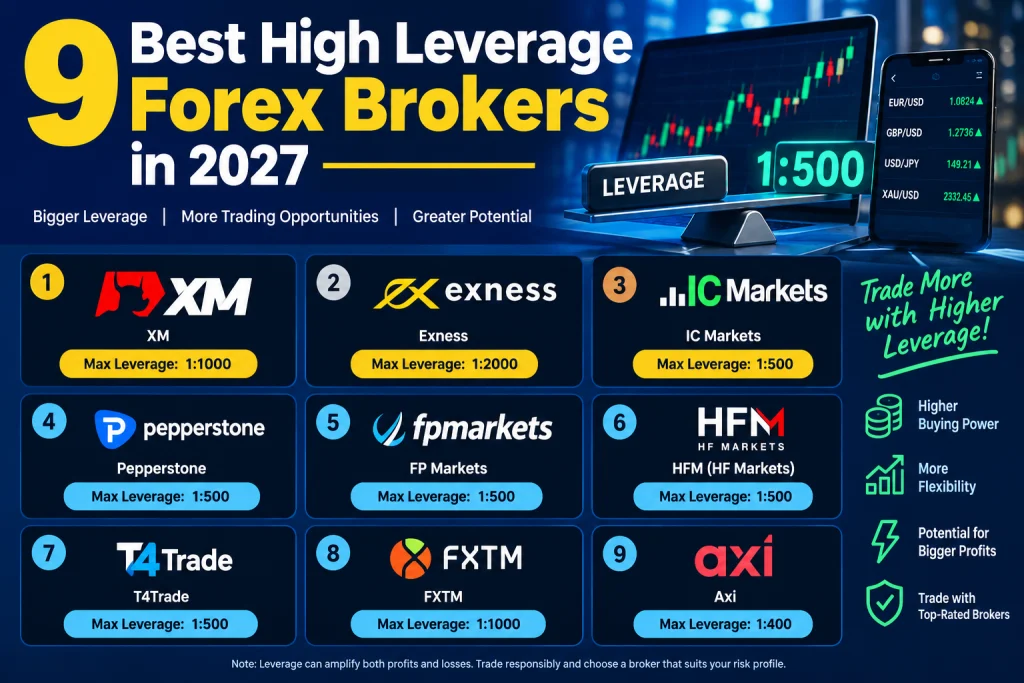
9 Best High Leverage Forex Brokers can give a small account far more buying power than most traders would otherwise have. A ratio of 1:1000 or 1:3000 lets you control a large position with a fraction of the capital, but the ratio is only one part of the picture. Regulation, capitalization, spreads and margin rules decide whether that leverage works in your favor.
📑 Table of Contents
This list covers nine brokers we reviewed for leverage limits, spreads, minimum deposit, regulation and account types (ECN, STP or market maker). Each entry explains who the broker suits best. US traders need a separate approach, because domestic rules cap leverage far lower than offshore brokers do, and we flag that where it matters.
How We Judged the Brokers
A high leverage ratio on a homepage tells you little on its own. We looked at the factors that determine how leverage behaves in practice:
- Leverage structure: whether the ratio applies uniformly or steps down as your balance grows.
- Margin rules: the margin call and stop-out levels that apply to your account.
- Regulator: which authority actually oversees the entity you open with.
- Costs: minimum deposit, spreads and commissions needed to open and trade.
Regulation is often assigned by entity, so the same broker can offer very different leverage depending on where you sign up. Always check the entity name in your agreement before you deposit.
9 Best High Leverage Forex Brokers at a Glance
The table below summarizes the key figures for each broker. Details can change, so confirm current terms on the broker’s website before opening an account.
| Broker | Maximum leverage | Margin call / stop-out | Regulators mentioned | Minimum to open |
|---|---|---|---|---|
| FBS | 1:3000 | 60% / 20% | IFSC Belize; CySEC entity for EU clients | $1 (cent), $100 (standard) |
| RoboForex | 1:2000 | 40% / 10% | IFSC Belize; CySEC arm for EU clients | $10 (Pro-Cent, Pro-Standard) |
| Exness | 1:2000 | 60% / 0% | FCA, CySEC, FSCA, FSA Seychelles | $1 (Standard), $200 (Raw Spread) |
| JustMarkets | 1:3000 | 100% / 20% | FSC Mauritius, FSCA, CySEC arm | $1 (Cent), $100 (Pro, Zero) |
| HFM | 1:2000 | 100% / 20% | FSA Seychelles, FSCA, DFSA, CySEC | No minimum (Zero Spread, Premium) |
| PU Prime | 1:1000 | 80% / 20% | ASIC, VFSC | $50 (Standard), $200 (Raw) |
| Moneta Markets | 1:1000 | 100% / 20% | FCA-authorized introducing arm, FSA Seychelles | $50 (Standard STP), $200 (ECN) |
| XM Group | 1:1000 | 50% / 20% | CySEC, IFSC Belize | $5 (Micro, Standard, Ultra Low) |
| PrimeXBT | 1:2000 | 50% / 20% | Seychelles registration; no CFTC or NFA oversight | $200 in crypto |
Detailed Reviews of the 9 Best High Leverage Forex Brokers
1. FBS: up to 1:3000 for aggressive traders
FBS offers some of the highest leverage in retail forex, reaching 1:3000 on its standard and cent accounts. At that ratio, $100 in the account can control a $300,000 position. The broker says it serves more than 27 million clients worldwide. For more context on this group, see our high leverage broker roundup or our FBS forex broker review.
Leverage: New accounts under $5,000 in equity qualify for the full 1:3000, which steps down automatically as the balance grows, reaching about 1:500 above $20,000. The cent account keeps 1:3000 regardless of balance. The margin call triggers at 60% and the stop-out at 20%.
Regulation: FBS Markets Inc. operates under the International Financial Services Commission (IFSC) in Belize, and a separate CySEC-regulated entity serves EU clients under lower leverage caps. The broker says it has operated since 2009 without a major regulatory action against it.
Costs: The cent account opens with $1 and the standard account with $100. Spread accounts start from about 0.5 pips with no commission. The Zero Spread account charges roughly $20 per round-turn lot.
| Account type | Min. deposit | Max leverage | Typical spread |
|---|---|---|---|
| Cent | 1:3000 | From 1.0 pip | |
| Standard | 0 | 1:3000 | From 0.5 pip |
| Zero Spread | 0 | 1:3000 | From 0.0 pip + commission |
Best for: scalpers and high-frequency traders testing strategies on small accounts. FBS does not accept US residents.
2. RoboForex: 1:2000 with ultra-low spreads
RoboForex pairs 1:2000 leverage with some of the tightest spreads among offshore brokers. Founded in 2009, it offers over 100 instruments across forex, metals, indices and crypto CFDs. Check our RoboForex ratings breakdown for current terms.

Leverage: The 1:2000 cap applies to Pro-Cent and Pro-Standard accounts regardless of balance. The margin call sits at 40% and the stop-out at 10%. Traders can lower leverage manually in account settings.
Regulation: RoboForex Ltd is regulated by the IFSC of Belize, with a CySEC-regulated arm for EU clients under capped leverage. Client funds are segregated, the broker publishes financial reports, and negative balance protection applies broker-wide.
Costs: Pro-Cent and Pro-Standard accounts require a $10 minimum, with spreads from 0.4 and 1.3 pips and no commission. The ECN account has spreads from 0.0 pips plus $4 commission per lot round-turn.
Best for: cost-conscious scalpers and day traders. US residents cannot open accounts.
3. Exness: flexible leverage up to 1:2000
Exness is one of the larger retail forex brokers. Its leverage adjusts with your equity and the instrument you trade, reaching 1:2000 on smaller accounts. Many competitors use fixed tiers, so this is a real point of difference.
Leverage: On Raw Spread and Standard accounts, leverage starts at 1:2000 for balances under $200 and falls gradually toward about 1:200 on larger accounts. Gold or index positions can carry lower ratios than EUR/USD on the same account. The margin call sits at 60% and the stop-out at 0%.
Regulation: Entities are regulated by the FCA in the UK, CySEC in Cyprus and the FSCA in South Africa, with an offshore license from the FSA in Seychelles for higher-leverage accounts. Segregated funds and negative balance protection apply.
Costs: The Standard account opens with $1, with spreads from 0.3 pips and no commission. The Raw Spread account needs $200, with spreads from 0.0 pips and about $3.50 commission per lot side.
Best for: traders who want leverage scaled to account size. US residents are excluded.
4. JustMarkets: 1:3000 with fast execution
JustMarkets matches FBS’s 1:3000 ceiling and emphasizes execution speed, with average execution under 100 milliseconds. Formerly known as JustForex, it serves clients in more than 160 countries. Our JustMarkets review covers current bonus terms.
Leverage: Leverage reaches 1:3000 on Pro and Cent accounts for balances under $2,500, then steps down as equity rises. The margin call triggers at 100% and the stop-out at 20%. A lower fixed tier can be requested.
Regulation: Entities are regulated by the FSC of Mauritius and the FSCA in South Africa, with a CySEC-licensed arm for EU clients. Client funds are segregated, and the broker reports no major sanctions since 2012.
Costs: The Cent account opens with $1 and spreads from 1.0 pip. The Pro account needs $100 with spreads from 0.5 pips. The Zero account needs $100, with spreads from 0.0 pips and about $3.50 commission per lot side.
Best for: active traders and news scalpers who need fast fills. US residents cannot open accounts.
5. HFM: 1:2000 across multiple regulators
HFM, formerly HotForex, combines 1:2000 leverage for offshore clients with fully regulated entities in stricter markets. It serves several million clients across Europe, Asia and the Middle East. Our HFM broker review has the full breakdown.
Leverage: Leverage depends on the entity you open with. The Seychelles entity offers up to 1:2000 on Zero Spread and Premium accounts, while the South Africa and UAE entities cap it lower. The margin call sits at 100% and the stop-out at 20%. Leverage can be reduced per account.
Regulation: HFM holds licenses from the FSA in Seychelles, the FSCA in South Africa, the DFSA in Dubai and CySEC in Cyprus. Client funds are segregated, and the broker publishes annual audited reports. It reports operating since 2010 without major sanctions.
Costs: The Zero Spread account has no minimum deposit, spreads from 0.0 pips and about $3 commission per lot side. The Premium account has no minimum, spreads from 1.2 pips and no commission.
Best for: traders who want a known brand and a choice of regulators. US residents are excluded.
6. PU Prime: ASIC-regulated with 1:1000
PU Prime offers a lower ceiling of 1:1000, but it holds a license from Australia’s ASIC, a tier-one regulator. Founded in 2015, it offers over 10,000 instruments. The PU Prime review covers the current deposit bonus.
Leverage: The full 1:1000 applies only to clients onboarded through the offshore Vanuatu entity. Clients under the ASIC entity face a much lower cap, close to 1:30 for retail clients, so confirm which entity you are signing up under. The margin call is 80% and the stop-out 20%.
Regulation: The ASIC license is the main credential, alongside a Vanuatu Financial Services Commission (VFSC) entity for offshore accounts. Client funds are segregated and negative balance protection applies. For a broader view of how we weigh oversight, read our guide to the best forex brokers for transparency and reliability.
Costs: The Standard account opens with $50, with spreads from 1.0 pip and no commission. The Raw account needs $200, with spreads from 0.0 pips and about $3.50 commission per lot side.
Best for: cautious traders moving up from micro accounts. US residents cannot open accounts.
7. Moneta Markets: FCA-linked oversight with 1:1000
Moneta Markets caps most retail leverage at 1:1000, but its FCA-linked oversight is rare among high leverage brokers. Launched in 2020, it offers over 1,000 instruments across forex, commodities and share CFDs. See our Moneta Markets review for current terms.
Leverage: The 1:1000 ceiling is available through the offshore Seychelles-regulated arm, while stricter jurisdictions cap it much lower. The margin call sits at 100% and the stop-out at 20%. Index positions need more margin than major pairs, so watch your usage closely.
Regulation: The broker operates an FCA-authorized introducing arm in the UK, plus offshore licensing from the FSA in Seychelles. Client funds are segregated, and negative balance protection applies across entities.
Costs: The Standard STP account opens with $50, with spreads from 1.0 pip and no commission. The ECN account needs $200, with spreads from 0.0 pips and about $3.50 commission per lot side.
Best for: cautious intermediate traders who want meaningful leverage with more oversight. US residents are excluded.
8. XM Group: 1:1000 built for beginners
XM has operated since 2009 and caps leverage at 1:1000 rather than chasing 2000:1 or 3000:1. It focuses on education, demo tools and onboarding, and reports over 10 million registered clients across 190 countries. See our XM broker review for account specifics.
Leverage: The Micro and Standard accounts reach 1:1000 for balances under $20,000, then step down as equity grows. The margin call sits at 50% and the stop-out at 20%. You can request a lower fixed tier at signup.
Regulation: XM operates through CySEC for EU clients and the IFSC of Belize for offshore accounts. Client funds are segregated, and the broker reports no major sanctions since launch.
Costs: The Micro and Standard accounts each need $5, with spreads from 1.0 pip and no commission. The XM Ultra Low account needs $5, with spreads from 0.6 pips and no commission.
Best for: first-time traders who value education and support. US residents cannot open accounts.
9. PrimeXBT: 1:2000 for US traders
PrimeXBT accepts US-based traders, which makes it one of the few realistic options for American clients seeking high leverage. Leverage reaches 1:2000 on forex and commodity CFDs through a crypto-margined structure. Launched in 2018, it began with crypto derivatives before adding forex and indices. The PrimeXBT review has current account terms.
Leverage: The 1:2000 ceiling applies across forex pairs, with lower caps on volatile indices and commodities. The margin call triggers at 50% and the stop-out at 20%. Because accounts are funded with crypto, margin also moves with the price of the funding asset.
Regulation: PrimeXBT does not hold a traditional tier-one forex license. It is registered in the Seychelles, and no CFTC or NFA oversight covers its US-facing operations. Crypto is held in segregated wallets with cold-storage custody, but you need to do more of your own due diligence than with regulated brokers. The CFTC website explains the US rules that restrict offshore brokers.
Costs: The minimum funding is $200 in crypto, with spreads from 0.5 pips on major pairs and no separate commission.
Best for: US residents shut out of offshore brokers and crypto-native traders. It is not the right choice if conventional regulatory protection matters more than leverage.
Choosing the Right High Leverage Broker
The nine brokers above make different trade-offs. FBS and JustMarkets offer 1:3000 for small, aggressive accounts. HFM, PU Prime and Moneta Markets accept lower ratios in exchange for stronger oversight. XM suits beginners, PrimeXBT serves US traders, and Exness shows that leverage that adjusts to your equity can be safer than a flat ratio.
Start with an honest self-assessment of your account size, risk tolerance and how much regulation you need. Risk management matters just as much. Our guide to forex risk management strategies for beginners is a useful read before you use high leverage on a live account.
Conclusion
High leverage can multiply gains and losses equally, and a fast liquidation can wipe out an account in minutes. The best high leverage forex broker for you is the one whose leverage, regulation and costs match your strategy. Compare current offers and terms before you deposit.
FAQ
Which forex broker offers the highest leverage?
FBS and JustMarkets both offer up to 1:3000 in this list, with FBS’s ratio stepping down as balances grow. Higher leverage also means higher risk, so check margin rules before choosing.
Is high leverage forex trading safe?
High leverage increases both profit and loss potential. Safety depends on your risk management, the broker’s regulation and whether you use stop-losses. Beginners should start with smaller positions.
Can US traders use high leverage forex brokers?
Most brokers in this list do not accept US residents. PrimeXBT is the exception, but it operates without CFTC or NFA oversight, so it carries different risks than a US-regulated broker.
What is the difference between margin call and stop-out?
A margin call is a warning that your margin level has dropped to a set percentage. A stop-out is the level at which the broker automatically closes positions to protect your balance.
Does a higher leverage ratio mean a better broker?
Not necessarily. Regulation, capitalization, spreads and execution speed matter as much as the leverage figure. A lower ratio from a well-regulated broker may suit you better.